Queer Places:
67 Wimpole St, London W1G 8AP, UK
Eton College, Windsor SL4 6DW, United Kingdom
University of Cambridge, 4 Mill Ln, Cambridge CB2 1RZ
St Andrew Church, Old Church Rd, Clevedon BS21 7UE, United Kingdom
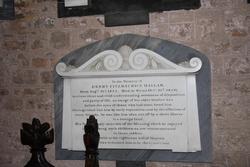 Henry Fitzmaurice Hallam (August 31, 1824 – October 25, 1850) was born on August 31, 1824, as the younger son of the distinguished historian Henry Hallam and Julia Maria
Elton. Named after his godfather, Lord Lansdowne, he grew up in a profoundly intellectual and accomplished Victorian family based in London at 67 Wimpole Street. Like his
older brother, the celebrated poet Arthur Henry Hallam, Henry displayed exceptional academic promise from an early age,
immersing himself in literature, poetry, and classical studies. He attended Eton College from 1836 to 1841, where he distinguished himself by winning the prestigious
Newcastle medal and cultivated a deep appreciation for writers such as William Wordsworth and Dante Alighieri.
Henry Fitzmaurice Hallam (August 31, 1824 – October 25, 1850) was born on August 31, 1824, as the younger son of the distinguished historian Henry Hallam and Julia Maria
Elton. Named after his godfather, Lord Lansdowne, he grew up in a profoundly intellectual and accomplished Victorian family based in London at 67 Wimpole Street. Like his
older brother, the celebrated poet Arthur Henry Hallam, Henry displayed exceptional academic promise from an early age,
immersing himself in literature, poetry, and classical studies. He attended Eton College from 1836 to 1841, where he distinguished himself by winning the prestigious
Newcastle medal and cultivated a deep appreciation for writers such as William Wordsworth and Dante Alighieri.
Continuing his education at Trinity College, Cambridge, which he entered in October 1842, Hallam pursued a brilliant academic and social trajectory. He earned a
scholarship on his first trial at Easter in 1844, secured the first declamation prize in his third year for an essay on "The Influence of Religion on the various Forms of
Art," and graduated as a senior optime alongside winning the second Chancellor's Medal in January 1846. Beyond his formal coursework across the Mathematical and Classical
Triposes, he left a lasting mark on university life by founding the "Historical" debating club during his first year, participating in the Cambridge Union—notably defending
the contentious Maynooth grant—and being elected to the elite, secretive intellectual society known as the
Cambridge Apostles. During his time at Cambridge and afterward, he formed close intellectual and personal bonds with
prominent figures such as Henry Sumner Maine and
Franklin Lushington, while also occasionally reading poetry with
Alfred Tennyson.
Following his graduation and the receipt of his Master of Arts degree in 1849, Hallam turned his focus toward the legal profession. He was admitted to the Inner Temple in
January 1844 and was officially called to the bar in May 1850, subsequently joining the Midland Circuit. However, his promising legal career was cut tragically short later
that year. While traveling through Italy with his family during the summer of 1850, he was taken seriously ill. Stricken by feebleness of circulation and exhaustion, he died
at the age of twenty-six on October 25, 1850, in Siena. His untimely death mirrored the profound family tragedies that had already claimed his siblings—including Arthur, who
died in 1833, Eleanor in 1837, and Julia—leaving his grieving father, Henry Hallam, without any surviving sons. His body was brought back to England, and on
December 23, 1850, he was buried by the side of his mother, sister, and brother at St Andrew's Churchyard in Clevedon, Somerset.
Regarding potential LGBTQ links, Henry Fitzmaurice Hallam operated within elite nineteenth-century homosocial and intellectual networks, most notably the Cambridge
Apostles—a society historically recognized for intense, deeply intimate homosocial bonding, homosocial romanticism, and homosocial male friendships among Victorian
intellectuals. While his brother Arthur Henry Hallam's profound emotional and homosocial attachment to Alfred Tennyson is famously immortalized in In Memoriam A.H.H.,
historical records concerning Henry Fitzmaurice focus primarily on his academic brilliance, gentle disposition, and deep friendships with peers like Maine and Lushington,
rather than explicit romantic documentation. Following his passing, a brief memoir composed by Maine and Lushington was privately printed to honor his memory, capturing the
deep affection he inspired among his peers. This tribute was later appended to the 1853 and 1863 reprints of his brother Arthur's Remains, ensuring that Henry's gentle
intellect and tragic, premature fate remained preserved alongside his family's literary legacy.
References:
Other references:
- Dictionary of National Biography (DNB): Comprehensive historical and biographical entry detailing Henry Fitzmaurice Hallam's birth, academic achievements at Eton and Trinity College, Cambridge, legal career, and death.
- Venn, John & Venn, J. A., Alumni Cantabrigienses: University admissions and biographical records for Trinity College, documenting his entry on January 26, 1842, scholarship wins, degrees (BA 1846, MA 1849), and membership in the Cambridge Apostles and the Historical debating club.
- Eton School Lists: Historical documentation of his enrollment and academic tenure at Eton College from 1836 to 1841, including his receipt of the Newcastle medal.
- Inner Temple Admission Registers: Records confirming his admission to the Inner Temple on January 10, 1844, and his subsequent call to the bar on May 3, 1850.
- Maine, Henry Sumner & Lushington, Franklin: Memorial Memoir of Henry Fitzmaurice Hallam (privately printed in 1850, and later added to the 1853 and 1863 editions of Arthur Henry Hallam’s Remains), providing contemporaneous tributes from his closest friends.
- Mignet, François-Auguste: Notice historique (read before the Académie des Sciences Morales et Politiques on January 3, 1862), containing family-sourced biographical details regarding Henry Hallam and his sons.
- Find a Grave & Parish Registers: Burial records for St. Andrew's Churchyard in Clevedon, Somerset, documenting his interment on December 23, 1850, alongside his mother, sister Eleanor, and brother Arthur Henry Hallam.
Support this project
This website is a passion project researched, developed, and funded entirely by me. If you find the content valuable and would like to help support the ongoing research and hosting costs, any contribution is deeply appreciated.
Thank you for keeping this independent resource alive!
My books on Amazon: Elisa Rolle's books
BACK TO HOME PAGE
